
Maverick County Court Records After Arrest
After a Maverick County arrest, the record path splits. The jail side answers whether a person was booked, is in custody, has a bond, or is being held for another agency. The court side answers what the prosecutor filed and what the judge did. A booking charge at Tom Bowles Detention Center is a starting point, not proof that the same charge was filed in court. Prosecutors can reject, amend, reduce, enhance, or replace arrest allegations.
Maverick County lists District Attorney Roberto Serna at 830-773-9268. The official directory lists District Clerk Leopoldo Vielma at 830-773-2629 and County Clerk Sara Montemayor at 830-773-2829. District-level felony matters often route through the district court and district clerk. County-level records may route through the county clerk. For custody and booking detail, use Maverick County jail inmate records. For booking-photo questions, use Maverick County jail mugshots.
Search Court Records After Arrest
The first online court-search route is re:SearchTX. The official landing page says it can search case information from all Texas counties and supports case number, case description, party, attorney, or judge searches. Public access can vary by case security, document type, user role, and account status, so a clerk contact may still be needed for certified copies or restricted items.
- Start with the arrest facts: name, date of birth, arrest date, arresting agency, booking charge, and any case or warrant number.
- Search re:SearchTX by case number when known, or by party name when the case number is not available.
- Open the case result and compare the filed charge to the booking charge.
- Check bond entries, warrants, hearings, attorney information, disposition, and sentence fields when visible.
- Call the District Clerk or County Clerk when public access does not show the needed document.
The Maverick County district court page and county courts page are local routing sources. Statewide conviction-history searches are separate and may route through the Texas DPS public criminal-history portal rather than the court docket.
The re:SearchTX landing page is the statewide case-search starting point for court records after a Maverick County arrest.
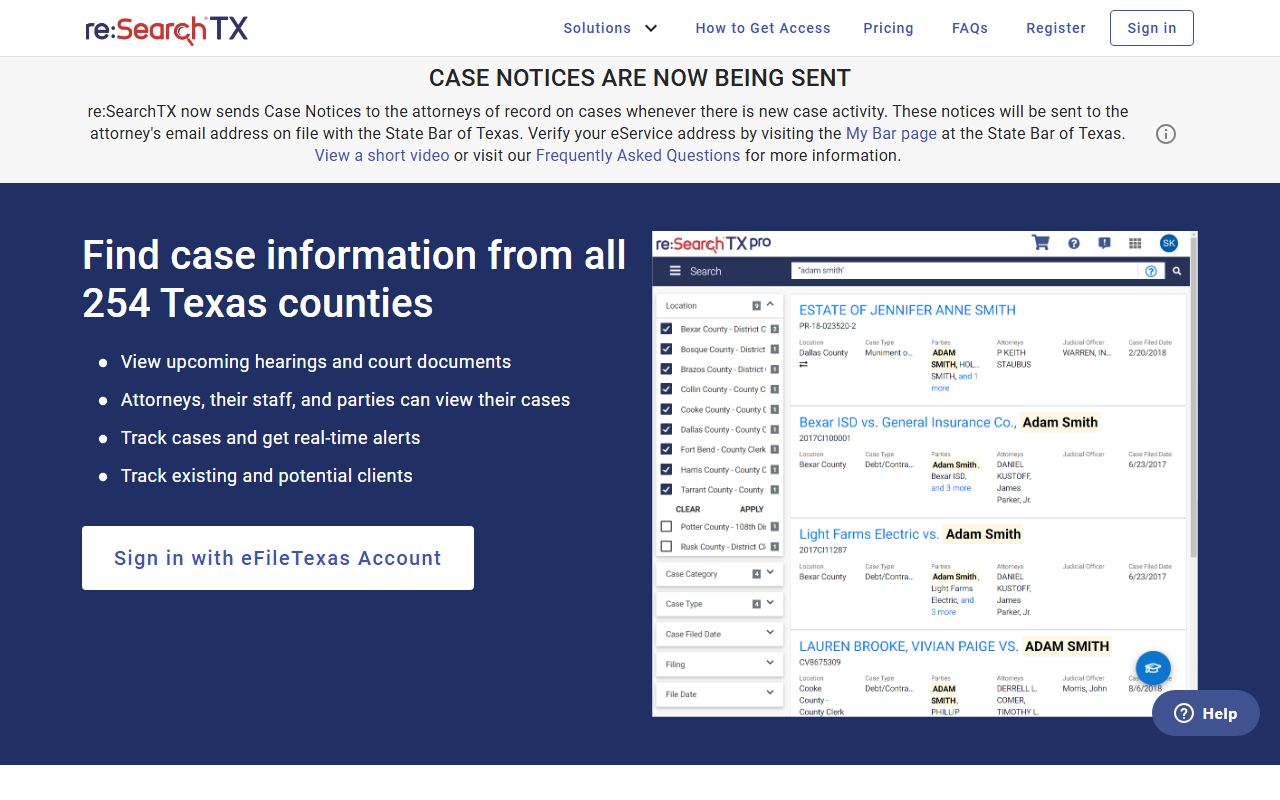
Use it for filed case information, then confirm record copies and certification with the correct clerk.
Maverick County Court Search Fields
re:SearchTX is broader than the jail phone route. It is designed for case information, not custody status. Search fields match the court case, so a person may need the spelling used in court filings rather than the spelling given during booking.
| Field Label | Type | Required | Notes |
|---|---|---|---|
| Case Number | Text | Optional | Best when known from jail paperwork or clerk notice. |
| Case Description | Text | Optional | Official page says case description can be searched. |
| Party | Text | Optional | Defendant, person, or business name route. |
| Attorney | Text | Optional | Search by attorney name when known. |
| Judge | Text | Optional | Helpful for known court assignments. |
| Login or account | Account | May be required | Access depends on document security and user role. |
Charges Filed After Arrest
A court record begins to take shape when a charging document is filed. A complaint may support early processing. An information is a prosecutor-filed charging instrument used in many non-indictment cases. An indictment is returned by a grand jury and is central for many felony prosecutions. These documents are the bridge between a jail arrest and a court case.
| Document | Who Uses It | What It Means |
|---|---|---|
| Complaint | Officer or prosecutor | Supports early criminal-case processing and accusation details. |
| Information | Prosecutor | Formal prosecutor-filed charge in non-indictment cases. |
| Indictment | Grand jury | Formal felony charging instrument returned by a grand jury. |
Maverick County Charge Status
Charge status can change after arrest. A court may show a pending charge, an amended charge, a dismissal, a warrant, a plea, a conviction, or a sentence. The key point is that a jail booking charge and the final court record may not match. Evidence review, witness statements, lab results, grand jury action, plea negotiations, or legal screening can change the charge.
| Status | What It Means |
|---|---|
| Pending | The case or charge is open and has not reached final disposition. |
| Amended or reduced | The charge was changed from the original filing or booking allegation. |
| Dismissed | The charge was ended by court or prosecutor action. |
| Warrant or capias | A court order may require arrest or appearance. |
| Convicted or sentenced | The case resulted in a plea, verdict, or sentence entry. |
Bond After Maverick County Arrest
Texas bond rules are governed mainly by Code of Criminal Procedure Chapter 17. The practical local path starts with arrest and booking, then moves to magistrate review where the person is informed of accusations and bond may be set. A person can still remain in custody after money is posted if another hold, detainer, warrant, parole issue, or federal authority blocks release.
| Bond Type | How It Works | Maverick County Action Point |
|---|---|---|
| Cash bond | Full amount paid as security. | Call the jail to ask where and how to post. |
| Surety bond | A licensed bondsman posts bond for a fee. | Confirm holds before paying a bondsman. |
| Personal bond | Release on promise and conditions. | Set by magistrate or court. |
| No-bond hold | Money alone will not release the person. | Ask which court or agency controls the hold. |
| Detainer | Another agency requests custody or notice. | Ask whether it is ICE, federal, parole, TDCJ, or another county. |
Warrants Before Court Records
No official Maverick County sheriff active-warrant search page was located in the researched sources. That does not mean a warrant does not exist. It means warrant questions route through sheriff phone, the issuing court or clerk, and records requests when releasable. Warrant types can include arrest warrants, bench warrants, capias warrants, fugitive warrants, and out-of-county holds.
Do not assume every warrant is handled the same way. A bench warrant after failure to appear may call for different steps than a new felony arrest warrant. Contact the issuing court, ask whether a bond has been set, and ask whether attorney appearance or a walk-in docket is available.
Charges vs Convictions
An arrest and a charge are not the same as a conviction. A charge is an accusation filed or pursued in court. A conviction requires a plea, verdict, or other qualifying final result. Texas DPS public criminal-history searches are separate from jail custody and local court docket searches.
| Charge | Conviction | |
|---|---|---|
| Stage | Accusation or filed count | Final plea, verdict, or judgment |
| Proof | Lower threshold at early stages | Must satisfy criminal-case proof rules |
| Record use | Shows what was alleged or filed | Shows case outcome |
Sealed and Expunged Arrest Records
Texas Code of Criminal Procedure Chapter 55 governs expunction of certain criminal records. Expunction can remove eligible arrest records from public view after qualifying outcomes. Sealing is different from expunction. A sealed record is restricted from ordinary public access, while an expunged record is treated differently under the legal order.
| Sealed | Expunged | |
|---|---|---|
| Public visibility | Restricted from ordinary public view | Removed or treated under the expunction order |
| Legal source | Depends on the record and order | Texas CCP Chapter 55 |
| Practical step | Use the court order and clerk process | Present the expunction order to agencies as directed |
Restricted Court Records After Arrest
Some records may not be public. Juvenile matters, sealed records, expunged records, confidential personal information, active law-enforcement details, and some document images can be restricted. Texas Government Code Chapter 552 creates a public-records route, but section 552.108 and other exceptions can limit release of law-enforcement information in certain cases.
Important: Do not use court records after arrest for FCRA-covered employment, tenant, credit, or insurance decisions.
Public Record Search
Sponsored Results